

Hey Posse! It’s Alex — and today we are talking about something that most herbal remedy guides completely skip over.
You’ve probably seen those cute “stress relief blend” recipes floating around Pinterest. Four herbs dumped together, zero explanation for WHY they work together, and honestly? Half the time they don’t. Not really. Because tossing herbs into a jar without understanding their constituents is like throwing random ingredients into a pot and hoping it tastes like soup.
The REAL secret to a professional-level formula is constituent compatibility — knowing which chemical compounds in your herbs work together, amplify each other, or straight-up clash. Once you understand this, your blends stop being guesses and start being genuinely powerful.
Why Most Herbal Blends Fail Before You Even Brew Them
Here’s the uncomfortable truth nobody wants to say: most DIY herbal recipes are built on vibes, not science.
And I get it! Herbs feel intuitive. They’re plants. How complicated can it be? But professional clinical herbalists — people like David Winston at the Herbal Therapeutics Research Library in New Jersey, who has been practicing for over 50 years. aren’t randomly combining chamomile and lavender because they both sound relaxing. They’re looking at constituent families: alkaloids, flavonoids, terpenes, tannins, volatile oils. They’re asking which constituents SUPPORT each other’s mechanisms of action and which ones compete for the same absorption pathway.
That’s the difference between a blend that works and a blend that looks good in a mason jar.
Understanding Constituent Compatibility Charts (And What They Actually Show You)
A constituent compatibility chart maps the primary active compounds in each herb against their known interactions, synergistic, neutral, or antagonistic. Think of it like a chemistry cheat sheet for your pantry.
So when you pull up a chart and see that rosmarinic acid (found in rosemary and lemon balm) pairs synergistically with apigenin (found in chamomile), that’s not a coincidence. Both constituents modulate GABA receptors. They’re hitting the same calming pathway from two different angles, which means together they can do more than either does solo. That’s a genuine synergistic herbal blend at the constituent compatibility level. the professional approach.
The charts typically organize herbs by their dominant constituent families. Tannin-rich herbs like oak bark and raspberry leaf might appear clustered together, while resin-bearing herbs like myrrh and propolis show up in a different zone. Your job is to pull from complementary zones, not redundant ones.
The Three-Layer Formula System Professionals Actually Use
Okay, so here’s how clinical herbalists actually BUILD a formula. There are three layers, and every professional blend I’ve ever seen follows some version of this structure.
First, your PRIME herb. This is the one doing the heavy lifting for your main goal. Say you’re building an anti-inflammatory blend. your prime might be turmeric, specifically chosen for its curcumin content, which inhibits NF-kB pathways. One herb. Clear purpose.
Second, your SYNERGIST. This herb amplifies the prime’s action. Black pepper (piperine) is the textbook example, it increases curcumin bioavailability by up to 2,000%, according to a 1998 study published in Planta Medica. Two herbs now, and they’re working like a team. THAT is synergy with actual evidence behind it.
Third, your CATALYST or corrective. This rounds out the formula, addresses a secondary concern, or improves tolerability. Ginger works beautifully here. it adds anti-inflammatory action via gingerols, AND it settles the digestive upset that straight turmeric sometimes causes in sensitive folks.
Three herbs. Clear constituent rationale. Professional result.
How to Read a Compatibility Chart Without Getting Overwhelmed
I’m not going to lie, the first time I sat down with a full constituent compatibility matrix, I felt like I was back in organic chemistry. It was A LOT.
But here’s the shortcut: focus on three constituent pairs that are well-documented and start there. Don’t try to memorize everything at once. Instead, look for herbs where the chart shows “enhances absorption,” “shares receptor affinity,” or “potentiates bioavailability.” Those are your green lights.
Red flags to watch? Tannin-heavy herbs paired with alkaloid-rich herbs. the tannins can literally bind to the alkaloids and reduce their effectiveness. Pairing valerian (alkaloids, isovaleric acid) with black tea (high tannins) in the same preparation, for instance, is a classic mistake beginners make. The chart would flag that immediately.
So use the chart as your filter BEFORE you get excited about combining herbs you love.
Ratio Matters as Much as Selection
Now, this is the part most blend tutorials completely ignore and it drives me crazy.
Even if your constituent compatibility is perfect, the wrong ratio tanks the formula. A 2020 review in the Journal of Ethnopharmacology looked at 47 traditional Chinese formulas and found that constituent interactions, including whether effects were synergistic or antagonistic. shifted depending on concentration ratios. The SAME two herbs could either support or interfere with each other based purely on proportion.
Professional herbalists typically weight their prime herb heaviest, somewhere between 40–60% of the total formula. Synergists run 20–30%. Catalysts and correctives fill the remaining 10–20%. These aren’t random numbers, they reflect decades of clinical observation.
I built my first properly-rationed blend back in 2021: a focus formula using lion’s mane (hericenones for NGF support), bacopa (bacosides for memory consolidation), and rosemary (rosmarinic acid for acetylcholine protection). Prime at 50%, synergist at 30%, catalyst at 20%. The difference compared to my old equal-parts approach was genuinely striking.
Building Your First Constituent-Compatible Formula Step by Step
Alright, let’s make this ACTIONABLE. Here’s the actual process, stripped down.
Start by defining ONE primary goal. Not “health and wellness”. something specific. Sleep support. Liver detox. Acute inflammation after workouts. Pick one.
Then identify your prime herb using a constituent chart, matched to that goal’s mechanism. Next, find one synergist whose key constituents operate on the same or a complementary pathway, not a redundant one. Add a catalyst that either improves delivery or addresses a likely secondary symptom. Check ALL three pairs on the compatibility chart for antagonistic flags. Then set your ratios using the 50/30/20 framework as your starting point.
Test it for at least 3 weeks before adjusting. Real constituent-level changes take time.
What I’d Do If I Were Starting From Scratch Today
Honestly? I’d spend two weeks just READING constituent charts before I blended a single thing. The Herbarium platform by the Herbal Academy has a solid one, and Matthew Wood’s “The Earthwise Herbal” gives you constituent breakdowns by herb that are worth their weight in gold.
Most people rush to blend because blending is the fun part. But the professionals I respect most. the ones whose formulas ACTUALLY work consistently, they do the boring chart work first. Every time. Because synergy isn’t magic. It’s chemistry you understand well enough to predict. And once you can predict it? That’s when your blends stop being pretty jars and start being genuinely useful medicine.
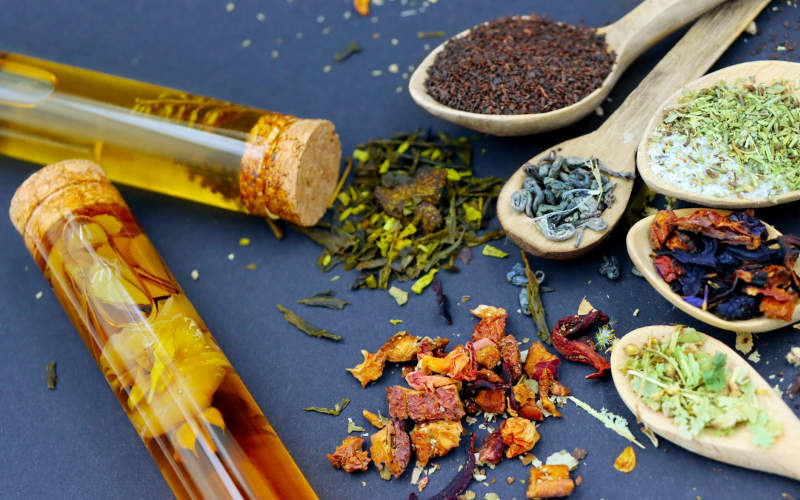
Photo by Marta Branco on Pexels

