
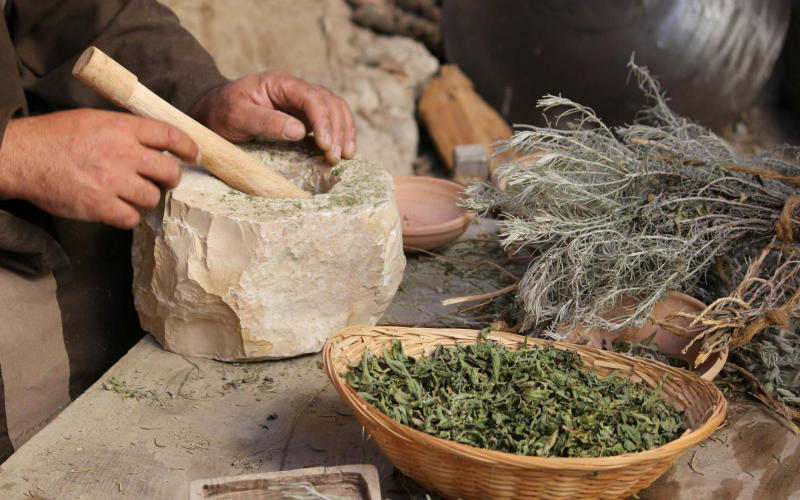

Hey Posse! Okay, so real talk — I grew up watching my grandmother move around her kitchen like some kind of plant whisperer. Dried bundles hanging from the ceiling, mason jars lined up on the windowsill, a little notebook with smudged ink and handwritten recipes she’d collected over decades. None of it had fancy labels. None of it came from a wellness influencer. And yet? The woman never got sick.
Here’s the thing nobody tells you: a LOT of those old herbal remedies actually work. And the herbs your grandmother leaned on — the ones that got quietly shelved when the pharmaceutical industry blew up in the mid-20th century — are finally getting the attention they deserve from serious modern herbalists. So if you’ve been googling forgotten medicinal herbs recipes and feeling overwhelmed by the options, I’ve got you. These five are the ones worth knowing.
1. Lemon Balm.
The Nervous System’s Best Friend
Lemon balm (Melissa officinalis) was basically THE herb for anxiety before anxiety even had a name. Grandmothers across Europe and North America kept it in their gardens specifically for “nerves,” and they weren’t wrong. A 2014 study published in Nutrients found that 600mg of lemon balm extract significantly reduced stress and improved mood in participants within just a few hours.
The recipe your grandmother probably used? A simple tea. Steep about 1.5 tablespoons of fresh lemon balm leaves, or one heaping teaspoon dried. in hot water for 10 minutes. Add raw honey. Drink it before bed. It’s genuinely that straightforward, and it smells incredible.
What I love is that modern herbalists like Rosemary Gladstar have been actively championing lemon balm for years now, pointing out that its antiviral properties also make it useful against cold sores caused by the herpes simplex virus. Your grandma probably didn’t know WHY it worked. She just knew it did.
2. Motherwort, The Heart Herb Nobody Talks About
Motherwort. Even the name sounds old. And it IS. this herb has been documented in traditional European and Chinese medicine since at least the 9th century. But I almost never see it show up in mainstream wellness content, which honestly frustrates me.
Motherwort (Leonurus cardiaca) was used traditionally for heart palpitations, anxiety tied to hormonal shifts, and menstrual irregularity. The active compound, leonurine, has shown real promise in modern research for its mild relaxant effect on heart tissue. A 2011 study in Phytotherapy Research confirmed it has measurable cardioprotective properties.
The classic recipe is a tincture: pack fresh motherwort into a glass jar, cover completely with 80-proof vodka, seal it, and leave it in a dark cupboard for 4 to 6 weeks. Shake it every couple of days. Strain, bottle, and use 1 to 2 ml up to three times daily when you feel your heart racing or your stress running hot. Now, fair warning, it’s BITTER. Like, aggressively bitter. But effective.
3. Goldenrod.
Criminally Misunderstood
Oh, goldenrod. This poor plant has been blamed for seasonal allergies for DECADES when it’s actually ragweed causing all the trouble. Goldenrod just gets bad press because it blooms at the same time. Your grandmother knew better.
Solidago virgaurea was a staple in old-world herbal medicine for urinary tract infections, kidney support, and even upper respiratory issues. German Commission E, which is basically Germany’s official herbal medicine regulatory body. has formally approved goldenrod for exactly these uses. That’s not nothing.
Goldenrod tea is ridiculously easy to make. Steep one teaspoon of dried goldenrod flowers and leaves in 8 ounces of boiling water for about 12 minutes, strain, and drink 2 to 3 cups daily during a UTI flare. I tried this myself last fall after a mild UTI, alongside (not instead of) medical advice, and was genuinely surprised by how fast the discomfort eased. It works. Stop sleeping on it.
4. Feverfew, Grandma’s Migraine Solution
Before sumatriptan. Before ibuprofen. Before any of that. there was feverfew (Tanacetum parthenium). And honestly? Modern research is catching up to what grandmothers were doing with this herb back in the 1800s.
Feverfew contains parthenolide, a compound that inhibits platelet aggregation and the release of inflammatory substances in the brain. A landmark clinical trial published in The Lancet back in 1988, yes, 1988. found that people who consumed feverfew daily experienced significantly fewer migraines than those on placebo. Fewer. Migraines. That’s huge.
The traditional recipe is simple: eat 2 to 3 fresh feverfew leaves daily, tucked into a sandwich (the leaves alone are bitter enough to make you wince). Or brew them into a tea using one teaspoon of dried herb per cup, steeped for 10 minutes. But here’s what most herb guides skip, feverfew works as PREVENTION, not as acute relief. You have to be consistent. Take it every day. Give it six to eight weeks. Don’t quit after one bad week.
5. Wood Betony.
The Herb Everyone Forgot
And now we get to the real hidden gem. Wood betony (Stachys betonica) was so wildly popular in medieval Europe that there was literally a saying: “Sell your coat and buy betony.” By the 20th century? Almost completely forgotten in North American herbalism. Which is a genuine shame.
Wood betony is a nervine, meaning it calms and tones the nervous system. and it’s also a digestive herb, making it particularly useful for the kind of tension headaches and stomach discomfort that come bundled together when someone is chronically stressed. Modern herbalist Matthew Wood has written extensively about its value for people who hold tension in their upper body and gut simultaneously.
The recipe here is a strong infusion: steep two teaspoons of dried wood betony herb in one cup of just-off-the-boil water for 15 full minutes (don’t rush it), strain, and drink slowly. It has a mild, slightly earthy taste. So add a little honey if you need to. Use it consistently over two to three weeks and pay attention to whether your shoulders stop creeping toward your ears quite so often.
Where to Start
Look, you don’t need to overhaul your entire medicine cabinet overnight. Pick ONE herb from this list, whichever one matches something you’re actually dealing with right now. and commit to trying it properly for four to six weeks. Not dabbling. Properly.
The uncomfortable truth is that most forgotten medicinal herbs recipes fail people because people treat them like a quick fix instead of a practice. Your grandmother didn’t brew one cup of lemon balm tea and declare it useless. She drank it every night. That consistency IS the medicine. Start there.
Photo by Huibre Venter on Pexels

