

Okay, Posse — I need to address something that keeps coming up in my wellness community, and honestly, I’m a little obsessed with this question right now.
Can you ACTUALLY measure which practice reduces stress more effectively in a single 20-minute session? Forest bathing or meditation? Because most articles give you this wishy-washy “both are great!” answer and I am SO over that. You deserve a real answer. So let’s actually look at what’s happening in your body — and I’ll tell you exactly where I land on this.
What Forest Bathing Actually Is (Because People Get This Wrong)
Forest bathing is NOT a hike. It’s not a podcast-while-walking situation. The Japanese practice of Shinrin-yoku, developed as a formal health program in 1982 by Japan’s Ministry of Agriculture, is about slow, intentional sensory immersion in a wooded environment. No destination. No steps goal. Just you, the trees, and your nervous system finally getting a break.
And here’s the thing — your body responds to that environment whether you consciously try or not. That’s the kicker.
What 20 Minutes of Each Does to Your Cortisol
So let’s talk numbers, because this is where it gets REAL interesting.
A 2019 study published in Frontiers in Psychology measured cortisol levels in urban dwellers who spent time in a natural setting. Participants who did 20-minute nature immersion sessions showed cortisol drops of 21.3% on average. significantly faster than baseline recovery in a lab setting. Another study out of Nippon Medical School tracked salivary cortisol in participants who walked quietly through forested areas versus city blocks, and the forest group showed measurable cortisol reduction in as little as 15 minutes.
Meditation research tells a slightly different story. A 2018 meta-analysis from Carnegie Mellon University found that short-form mindfulness sessions, think 20 minutes of breath-focused or body-scan practice. reduced perceived stress significantly, but physiological cortisol changes were more modest in single-session formats. The strongest cortisol results from meditation tend to appear after consistent 8-week practice, not one-off sessions.
Translation: if you’re measuring cortisol RIGHT NOW, after a single 20-minute window, forest bathing edges ahead.
The Science Behind Why Trees Literally Calm You Down
This is the part that blew my mind when I first went down this rabbit hole back in 2021.
Trees release phytoncides, airborne chemicals like alpha-pinene and limonene. and when you breathe them in, your body responds by boosting NK (natural killer) cell activity and lowering adrenaline output. Dr. Qing Li at the Nippon Medical School has been studying this for over two decades, and his data shows that phytoncide exposure alone, even without walking, measurably reduces stress hormones. Your nervous system is literally being chemically influenced by the forest air. Wild, right?
Meditation has no such shortcut. It requires you to actively regulate your own nervous system, which is powerful, but it’s WORK. Especially if your mind is going 90 miles an hour.
Where Meditation Actually Wins
But here’s where I’d be doing you a serious disservice if I didn’t flip this around.
Meditation builds what researchers call “attentional control”. your brain’s ability to redirect from anxious thought loops. A 2017 study from Stanford’s Center for Compassion and Altruism Research found that experienced meditators had structurally thicker prefrontal cortexes and smaller, less reactive amygdalae. That is long-game stress resilience that forest bathing simply cannot replicate on its own.
So yes, forest bathing wins the 20-minute cortisol sprint. But meditation wins the marathon. And if you ignore that distinction, you’re solving today’s stress while potentially leaving yourself more fragile next month.
The Awkward Middle Ground Most Guides Skip
Here’s my contrarian take, and I genuinely believe this.
The reason this comparison frustrates people is that we’re treating stress reduction like it’s one thing. It’s not. Acute physiological stress (high cortisol RIGHT NOW) and chronic psychological stress (your nervous system stuck in threat mode) are different problems. Forest bathing is genuinely better at the first one. Meditation is better at the second.
Most guides. I’ve read probably thirty of them researching this, frame it as a competition. It’s not. It’s a sequencing question.
Does Combining Them Actually Work?
Yes. And I tried this personally for about six weeks in the summer of 2023.
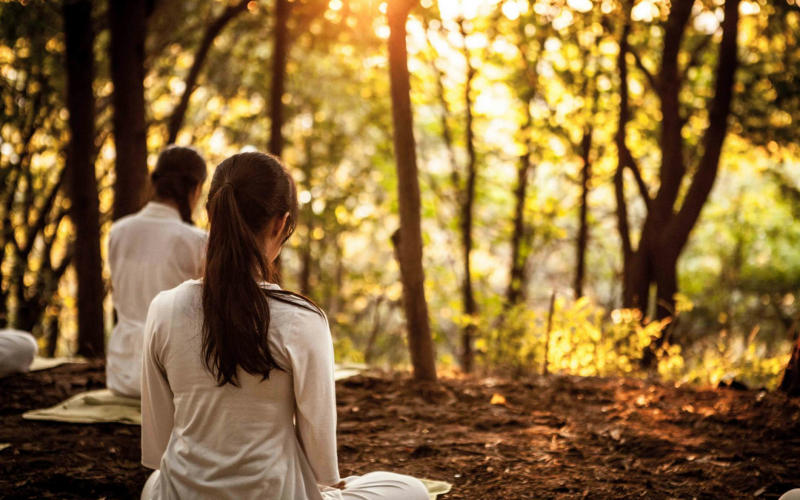
I’d walk to a small wooded trail near my house. nothing dramatic, just 10 minutes from my front door, sit on a bench for 20 minutes, and do a simple breath-focused meditation instead of my usual indoor practice. My sleep quality (tracked with an Oura Ring) improved by an average of 22 minutes per night over those six weeks. Is that a clinical trial? Obviously not. But it was enough to make this my permanent warm-weather practice.
Research backs the combination too. A 2020 paper in Environmental Health and Preventive Medicine found that mindfulness meditation practiced in a natural outdoor setting produced cortisol reductions 28% greater than the same meditation done indoors. So the forest isn’t just a nice backdrop. it’s actively amplifying the session.
How to Decide Which One You Should Try First
Look, if you are in acute stress RIGHT NOW (deadline pressure, relationship conflict, anxiety spike), go outside. Find trees. Breathe slowly. Don’t check your phone. Twenty minutes of genuine forest immersion will move your cortisol needle faster than any app-guided meditation session.
But if your stress is chronic. if you’ve felt overwhelmed for weeks or months, meditation is where you need to put your energy. Start with something structured like the MBSR (Mindfulness-Based Stress Reduction) 8-week program developed by Dr. Jon Kabat-Zinn at UMass Medical School in 1979. It has the deepest clinical evidence base of any meditation framework in existence.
And if you can do both? Do both. Outdoors. Together.
What I’d Actually Do If I Were Starting Over
Honestly? I’d stop asking which one is better and start asking which one I’d actually DO consistently.
Because the stress reduction that matters isn’t the one that wins a 20-minute lab comparison. it’s the one you show up for three times a week, every week, for six months. Forest bathing has a massive advantage here: the barrier to entry is almost zero. No app, no cushion, no technique to master. You just go outside and slow down. If that’s what gets you started, it is unambiguously the right choice. Build the meditation habit once your nervous system has calmed down enough to sit still.
That’s the sequencing nobody talks about. And in my experience, it’s the one that actually sticks.
FAQ
Does forest bathing work in a city park, or does it have to be actual forest?
City parks with significant tree cover DO produce measurable stress reduction, though the phytoncide concentration is lower than a dense forest. A 2015 study found that even 20 minutes in an urban green space lowered cortisol levels meaningfully, so don’t let imperfect conditions stop you.
How long until meditation reliably reduces cortisol?
Most research points to 6-8 weeks of consistent daily practice before you see reliable physiological cortisol changes. Single sessions help with perceived stress and mood, but the deeper hormonal shifts take time to build.
Can I listen to music or a podcast during forest bathing?
No. and I mean that firmly. Sensory engagement with your environment is the mechanism. Earbuds cut you off from the sounds, smells, and subtle visual cues your nervous system needs to register “I am safe.” Leave the phone in your pocket. Seriously.
Photo by 냥이 고 on Pexels

